
Results from the AA-Omniscience Benchmark
fastCRW scores 90.0% on all 600 AA-Omniscience questions and beats every product on the Artificial Analysis Search Index board: Firecrawl 73, Exa 70, You.com 69, Parallel 68, Brave 65, Tavily 64. A 17-point margin over the closest one, validated with a control run.
On the full 600-question AA-Omniscience set, fastCRW answers 90.0% correctly and finishes ahead of every product on the public Artificial Analysis Search Index. The closest is Firecrawl at 73, then Exa at 70, You.com at 69, Parallel at 68, Brave at 65 and Tavily at 64. The 17-point margin over the leader is as wide as the entire spread between first and last place on that board. It comes from the default configuration, a plain POST /v1/search with no flags, and it was validated by running a listed provider through the same harness and reproducing its published score to within 1.5 points.
What this benchmark measures
AA-Omniscience is the answer-accuracy benchmark on the Artificial Analysis Search Index, the public board that scores agent search APIs. It is 600 factual questions spread across six domains: finance, health, humanities and social sciences, law, science engineering and mathematics, and software engineering.
The questions are narrow and the answers are short. A typical one asks which specific clause of an accounting standard governs a named arrangement, or what figure a particular study reported. Median answer length is six characters. The metric is deliberately blunt: LLM-graded accuracy at one attempt, with the same grader applied to every provider on the board.
That shape is what makes it a clean read on retrieval. There is no partial credit and no room for a long answer to hide a miss. Either the search layer put the right document in front of the model or it did not.
Results
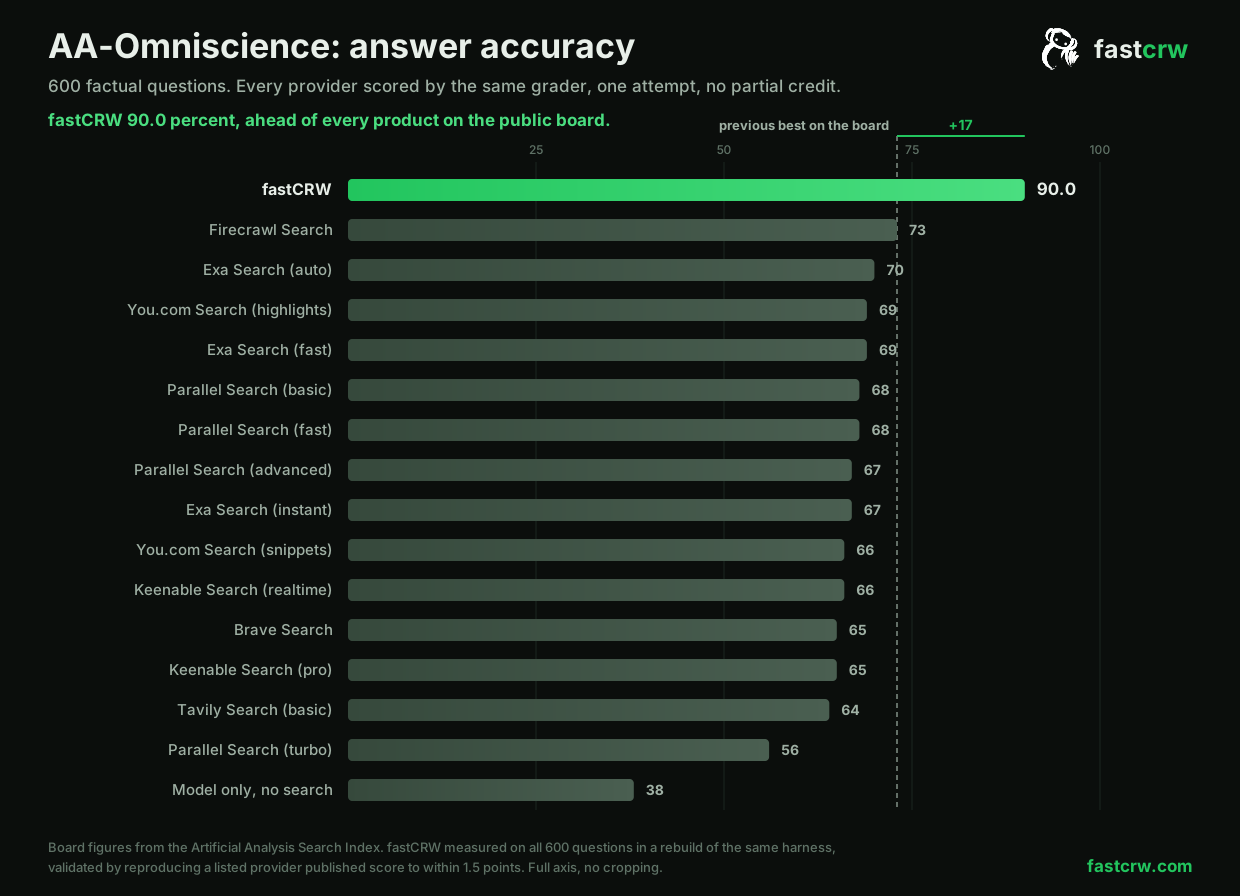
fastCRW answered 540 of the 600 questions correctly. Every product currently listed on the board, from every provider, sits below it.
| Provider | Accuracy | Gap to fastCRW |
|---|---|---|
| fastCRW | 90.0% | |
| Firecrawl Search | 73 | 17 points |
| Exa Search (auto) | 70 | 20 points |
| You.com Search (highlights) | 69 | 21 points |
| Exa Search (fast) | 69 | 21 points |
| Parallel Search (basic) | 68 | 22 points |
| Parallel Search (fast) | 68 | 22 points |
| Parallel Search (advanced) | 67 | 23 points |
| Exa Search (instant) | 67 | 23 points |
| You.com Search (snippets) | 66 | 24 points |
| Keenable Search (realtime) | 66 | 24 points |
| Brave Search | 65 | 25 points |
| Keenable Search (pro) | 65 | 25 points |
| Tavily Search (basic) | 64 | 26 points |
| Parallel Search (turbo) | 56 | 34 points |
| Model only, no search | 38 | 52 points |
Three things are worth pulling out of that table.
The margin is not a rounding difference. The closest product is 17 points behind. The spread across all fourteen listed products is 17 points end to end, from 56 to 73, so the distance between fastCRW and the current leader is as large as the distance between the current leader and last place.
Every provider's best mode is in there. These are not the cheap configurations. Exa auto, You.com highlights and the strongest Parallel tier are the modes those providers put at the top of their own boards, and the pattern holds across all of them.
Search is doing the work, not the model. The same answer model with no search at all scores 38. Every product on the board is measured on how far above that line it lifts the answer. The best listed lift is 35 points. Ours is 52.
Why there is a control run
The board's numbers were produced by Artificial Analysis in their harness. Ours were produced in a rebuild of that harness. Those are two different things, and a score measured in your own harness is worth very little on its own.
So before measuring ourselves we ran a provider that is already listed on the public board through our harness, on the same questions, and compared what we got against what they published.
| Run | Our harness | Published on the board |
|---|---|---|
| Listed provider, control | 74.5% | 73 |
A gap of 1.5 points on a 200-question subset. That bounds how much our rebuild differs from theirs, and it is the only reason we consider our own number publishable. It is a bound, not proof of identity.
On that same 200-question subset, measured side by side in the same harness on the same day:
| Run | Accuracy |
|---|---|
| fastCRW | 89.5% |
| Control provider | 74.5% |
The configuration that produced it
The default one. A plain request, no flags:
curl -X POST https://fastcrw.com/api/v1/search \
  -H "Authorization: Bearer $CRW_API_KEY" \
  -H "Content-Type: application/json" \
  -d '{"query": "ASC 340-30 deposit arrangement categories", "limit": 10}'
What this number does not say
The grader is a language model. The same grader scores every provider in every run, which makes the comparison internally fair, but it is not a human adjudicator.
The harness is ours. The control run bounds the difference at about a point and a half on this dataset. That is why the number is here, and it is also why the bound is stated rather than buried.
The full write-up, including how the harness was rebuilt and what it cost to run, is in the engineering post.
Reproducing it
Everything above is repeatable. The dataset is AA-Omniscience-Public on Hugging Face, and the harness constants are published in the Artificial Analysis search methodology. The fastCRW side is the single request shown above. The free tier needs no card, so a meaningful subset costs nothing to repeat.
If you rebuild it, run a listed provider as a control before you trust your own number. That one step is the difference between a benchmark and a press release.
Continue exploring
More from Benchmarks
Results from the 1,000-URL Firecrawl Dataset Benchmark
A 3-way benchmark of fastCRW, Crawl4AI, and Firecrawl on Firecrawl's own public 1,000-URL scrape-content dataset — truth-recall, scrape-success, and the full p50/p90 latency split.
Search Benchmark: fastCRW vs Tavily vs Firecrawl
100-query concurrent search benchmark comparing fastCRW, Tavily, and Firecrawl on latency, win rate, and reliability across 10 query categories.
fastCRW Benchmark Methodology
How fastCRW frames internal and third-party benchmark claims, including metric definitions, source provenance, and interpretation rules.
Related hubs