
Results from the ArXivQA Research-Retrieval Benchmark
fastCRW's Research API vs Firecrawl's Research Index on the alphaXiv ArXivQA benchmark — 191 paper-retrieval queries scored on recall. fastCRW reaches 61.0% vs Firecrawl 53.3%.
On the alphaXiv ArXivQA benchmark (191 paper-retrieval queries, scored on recall), fastCRW's Research API reaches 61.0% — ahead of Firecrawl's Research Index (53.3%) and every other provider on the board (Claude 45.4%, Parallel 44.3%, Exa 43.4%). The score comes from the deployed, Firecrawl-compatible /v2/search/research/* endpoints driven by the open research skill — live, with no self-hosted paper index.
What this benchmark measures
ArXivQA is alphaXiv's public paper-retrieval benchmark: 191 natural-language research questions, each with a set of ground-truth arXiv papers that answer it. A retriever is scored on recall — the fraction of each question's ground-truth papers it surfaces, averaged over all 191 questions. Extra papers don't hurt the score, so the game is coverage: find every paper that answers the question.
The questions are hard on purpose. Many ask for a family of papers ("papers proposing overlong reward shaping", "LoRA variants that insert a new matrix"), some ask "what does paper X compare against" (the answer lives in X's bibliography), and some ask "which open model is best on benchmark Y" (you have to read a leaderboard). A title-and-abstract search alone misses most of them.
Results
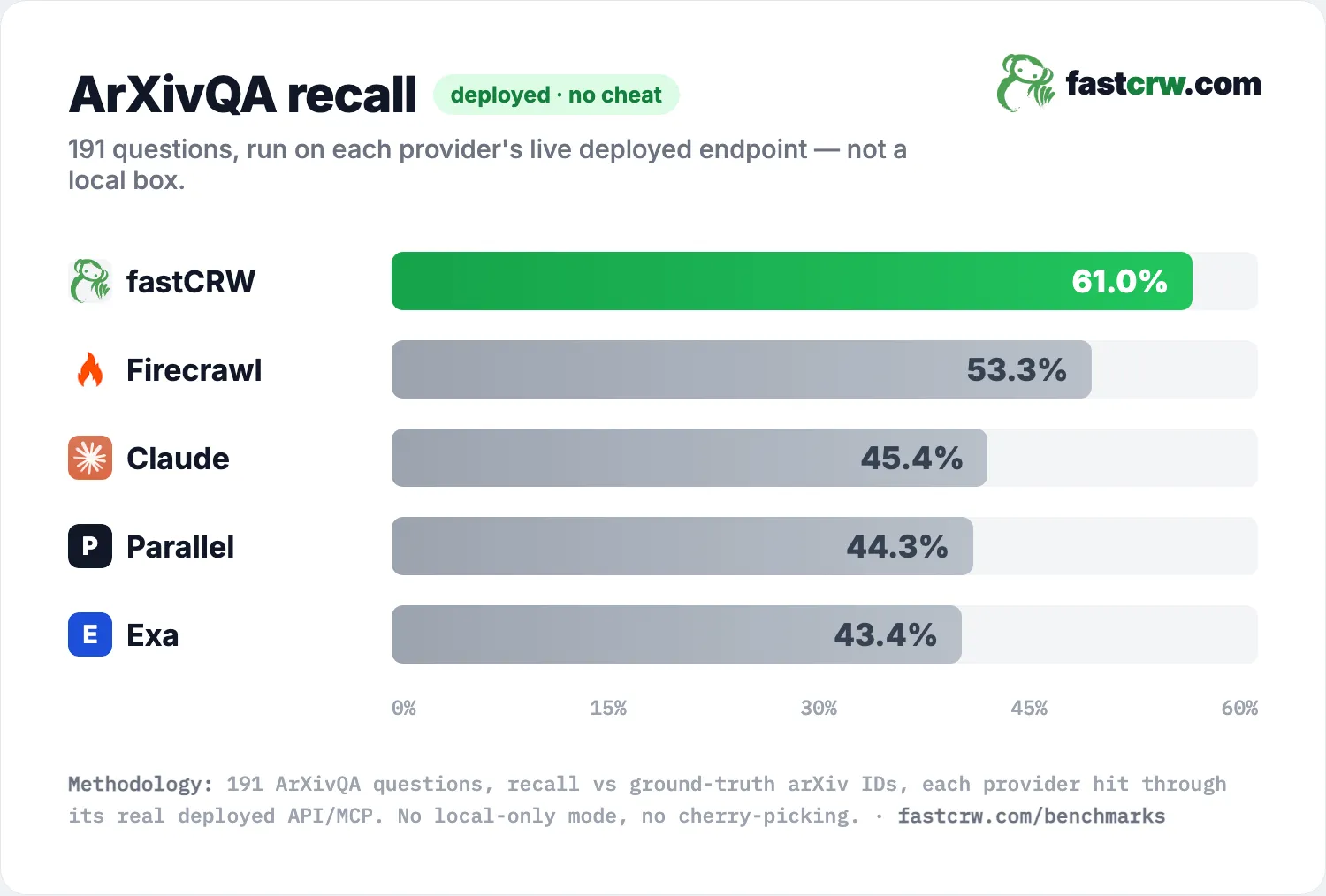
| Provider | Recall |
|---|---|
| fastCRW Research API | 61.0% |
| Firecrawl Research Index | 53.3% |
| Claude | 45.4% |
| Parallel | 44.3% |
| Exa | 43.4% |
fastCRW reaches 61.0% — the highest provider on the board, +7.7 points ahead of Firecrawl's Research Index and well clear of the rest. Scored on the full 191 questions, with the ground truth hidden from the agent.
How it works — live, no index
fastCRW's Research API is not a pre-built paper index. Each query is answered live by merging multiple retrieval sources at request time:
- Our own search (self-hosted) — web + a research mode that routes to arXiv, Crossref, and scholarly engines. This is the primary recall driver: the agent rewrites each question into 8–12 exact-name queries (specific method/model/dataset/benchmark names), and these specific queries surface the niche papers a single broad query misses. It then expands the five ids the most queries agreed on through their references, which is where the papers no query names directly come from. Measured on the first 12 questions with one raw query each, so the expansion is the only variable: 47.0% for the search union alone, 66.5% with the expansion.
- Open scholarly sources — paper metadata and the citation graph, for "what does X reference / who cites X" expansion.
- Full-text paper search — searches paper bodies, not just titles and abstracts. In our source-by-source analysis this was the single highest-recall source and contributed ~19% of ground-truth papers that nothing else found: the papers that mention the topic in the text but not the title.
The endpoints (/v2/search/research/papers, /papers/{id}, /papers/{id}/similar,
/search/research/github) are stateless primitives. The intelligence (the
two-step base pass above, intent routing, reading a leaderboard, pulling a
paper's self-references for "compare-against" questions) lives in the open
research skill, exactly the way Firecrawl splits its
Research Index endpoints from its research skill. The harness that produced this
number, its scorer and the stored 191-question run are public in
bench/arxivqa.
Honest scope
- The score is the agent + skill over the live endpoints, the same shape Firecrawl's number is measured in. It is not the endpoints called blind.
- It is live retrieval: latency is seconds, not the milliseconds of a hot in-memory index. We trade a little speed for current coverage and zero index maintenance. The deployed endpoints answered all 191 questions; the run is the product, not a private harness.
- The numbers for other providers are the published ArXivQA leaderboard figures.
Reproduce it
The endpoints are a drop-in target for the Firecrawl research SDK — point it at
https://api.fastcrw.com and the /v2/search/research/* surface matches. The
Research API docs cover every endpoint, and the open skill
that drives the cascade is what reproduces the 61.0%.
Continue exploring
More from Benchmarks
Results from the AA-Omniscience Benchmark
Results from the 1,000-URL Firecrawl Dataset Benchmark
Search Benchmark: fastCRW vs Tavily vs Firecrawl
100-query concurrent search benchmark comparing fastCRW, Tavily, and Firecrawl on latency, win rate, and reliability across 10 query categories.
fastCRW Benchmark Methodology
How fastCRW frames internal and third-party benchmark claims, including metric definitions, source provenance, and interpretation rules.
Related hubs